
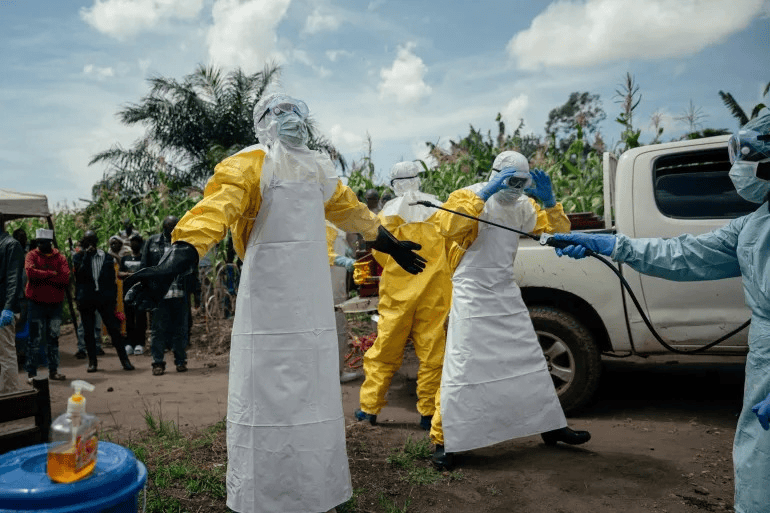
The Democratic Republic of the Congo (DRC) is now facing its largest Ebola outbreak ever recorded, with 4,665 confirmed cases and 2,184 deaths as of 12 August 2026, according to the World Health Organization (WHO).
The outbreak, caused by the Bundibugyo virus, has spread across 54 health zones, with Ituri Province accounting for about 85% of confirmed cases. The reported case-fatality rate stands at 46.8%. This is not only a medical emergency. It is also a race against time to know what is happening inside affected communities as
Ebola response depends on finding cases early, tracing contacts, getting people into care and stopping transmission. But in areas affected by insecurity, difficult roads, population movement and limited access to communities, reaching everyone physically can be challenging.
And when people cannot be reached easily, important information can be missed.
A family may be afraid to visit a health centre. A community may have heard a rumour about Ebola and stopped trusting health workers. A caregiver may be struggling to access treatment. A healthcare worker may know about a problem that has not yet reached the attention of decision-makers.
These are the stories that numbers alone cannot tell.
What if organisations could simply call?
Telephone research can give public-health organisations another way to listen.
Through Computer-Assisted Telephone Interviewing (CATI), trained interviewers can speak with people remotely, collect structured responses and quickly identify patterns in what communities are experiencing.
For an Ebola response, telephone surveys could help organisations understand:
• Whether people recognise Ebola symptoms and know where to seek help
• Why some people may delay seeking medical care
• Whether communities trust health authorities and response teams
• How misinformation and fear are affecting behaviour
• Whether health messages are reaching people and being understood
• What patients, caregivers and healthcare workers say they need
• Whether health interventions are reaching the people they are designed to support
CATI does not replace medical diagnosis, treatment, laboratory testing or contact tracing.
Instead, it provides another way to hear from people who may otherwise be difficult or unsafe to reach through face-to-face research.
Uganda shows why cross-border information matters
The risk is not limited to the DRC.
Uganda recorded 20 confirmed cases and two deaths, with 15 cases imported from the DRC and five secondary cases linked to those infections, according to the World Health Organization. Although Uganda has since brought that outbreak under control, WHO continues to identify the country as vulnerable to re-introduction because Ebola transmission is still occurring across the border in the DRC.
That makes community information especially important in countries connected by travel, trade and population movement.
An organisation does not always need to send a research team into every community to understand what people are thinking, experiencing or struggling with.
Sometimes, the safest way to ask is to pick up the phone.
Where CATI Africa can help
For governments, NGOs, healthcare organisations, humanitarian agencies, development partners, researchers and other organisations working on public-health programmes, fast and reliable information can make a real difference to how interventions are planned and improved.
CATI Africa provides telephone research and data collection services across African markets, including questionnaire design, CATI programming, respondent screening, telephone interviewing and reporting.
The company has conducted more than 200,000 interviews across 10+ African countries, giving organisations a way to reach respondents remotely and collect structured data at scale. CATI Africa
In an outbreak such as Ebola, this approach can help organisations ask a simple but important question:
What are people experiencing right now, and what needs to change?
The answer could reveal gaps in health communication, barriers to treatment, community concerns or problems with an intervention before they become bigger challenges.
The next Ebola response must listen as well as act
The DRC outbreak is a reminder that fighting Ebola is not only about what happens inside treatment centres.
It is also about what happens inside homes, communities and people's decisions.
When people are afraid, when information is unclear or when healthcare feels out of reach, those factors can influence how quickly an outbreak is detected and contained.
That is why telephone surveys, remote interviews and community feedback should be part of the wider public-health response toolkit.
Because organisations cannot solve a problem they do not fully understand.
And sometimes, getting closer to the people affected does not require travelling closer to the danger.
It starts with listening.
Talk to CATI Africa about telephone research and data collection across Africa.