
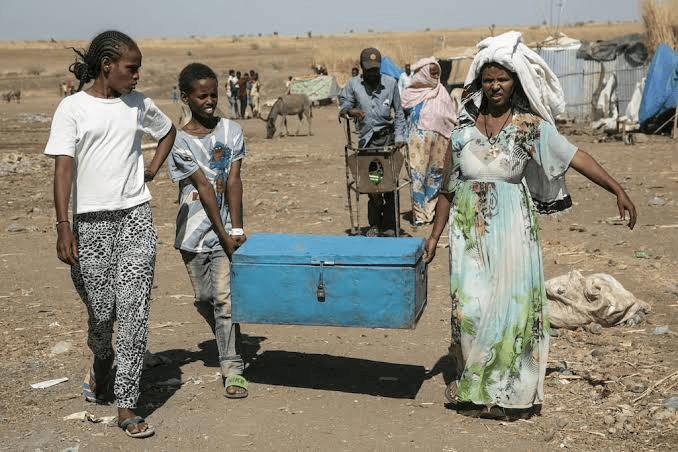
Ethiopia is not facing just one war. It is facing three overlapping conflicts in Tigray, Oromia and Amhara that are pushing the country toward possible breakup, rising violence, displacement and access constraints are making traditional fieldwork too dangerous or impossible in many areas.
For governments, aid groups, and businesses that still need reliable information on displacement, prices, market access, and security perceptions, the big question is: how do you collect safe data in conflict zones without putting staff and respondents in danger?
Understanding how to generate safe data in conflict zones is now essential for anyone working on Ethiopia.
Understanding Ethiopia's Three Conflicts to Design Safe Data in Conflict Zones
In Tigray, the fighting that restarted in August 2026 is mostly about who really runs the region and how the 2022 Pretoria peace deal is being applied. That peace deal set up a federally appointed interim administration to govern Tigray while bigger questions like disarmament, security reforms, disputed lands, and political status were supposed to be worked out.
By 2026, that plan had fallen apart, with the hardline faction of the TPLF rejecting the interim administration, bringing back the pre‑war Tigray council, and electing Debretsion as regional president in May 2026.
This created two rival governments in Mekelle: one supported by many locals but not recognized by Addis Ababa, and one recognized by the federal government but increasingly sidelined.
Clashes that began in early August 2026 around Sheraro and other border towns are among the most serious violations yet of the Pretoria deal, raising fears of a return to full‑scale war.
For more background on the broader conflict, see the Council on Foreign Relations' tracker on conflict in Ethiopia.
Oromia: Rebellion, Identity, and Control
In Oromia, the main fighting involves the Oromo Liberation Army (OLA) and the government, along with wider disputes over political representation, land, and identity.
Key drivers include a long‑running rebellion by the OLA against federal and regional authorities, framed around Oromo self‑determination, feelings of marginalization, and grievances over land and resources.
Heavy‑handed counter‑insurgency tactics, including mass arrests, displacement, and reports of abuses, push more people to support or join armed groups.
The result is a long, grinding insurgency where the central government struggles to fully control the region, and civilians are caught between rebels, state forces, and local militias.
For a wider view of the conflict dynamics, you can also refer to the Council on Foreign Relations' overview of conflict in Ethiopia.
Amhara: Fano Militias, Land, and the Federal System
In Amhara, the main fighting is between federal forces and Fano militias, which started as pro‑government groups during the Tigray war but later turned against Addis Ababa.
Core issues include control of territory, especially in western Tigray and border areas, where Fano fighters and Amhara nationalists resist any return to pre‑2020 boundaries that would put these areas back under Tigray administration.
Between February and August 2026, conflict monitors recorded well over 100 battle events across dozens of districts in Amhara and Oromia, with hundreds of fighters killed and many civilians displaced or killed in multiple areas.
More than 8 million people were exposed to conflict in this period, and internal displacement remains severe, especially in Amhara and parts of Oromia.
For recent updates on the fighting in Amhara, see this summary of war updates from Amhara Region, Ethiopia.
Why Safe Data in Conflict Zones Matters for Ethiopia's Decision‑Makers
For researchers, aid organizations, and investors, these overlapping wars create a simple but harsh reality: many of the places where you most need data are now too dangerous to visit.
Roads are blocked by checkpoints run by different armed groups, frontlines move quickly, and identity‑based violence and arbitrary arrests make travel especially risky for anyone seen as an outsider or linked to a particular community.
Yet decisions on food aid, cash support, market entry, and security policy cannot wait for "when things calm down." They need timely, credible, and detailed data even in the middle of a crisis.
For a live view of where fighting is happening, you can check this Ethiopia conflict map.
How CATI Africa Delivers Safe Data in Conflict Zones in Ethiopia
CATI Africa exists for exactly this kind of moment. Our phone‑based (CATI) research methodology allows governments, NGOs, and businesses to keep producing high‑quality evidence in Ethiopia without putting staff in the line of fire.
Instead of relying on in‑person surveys in high‑risk districts, we design mobile phone samples that reflect the populations you need to understand displaced people, host communities, traders, health workers, youth.
We conduct structured interviews by phone from secure locations, using computer‑assisted systems that enforce question flows, real‑time checks, and supervisor monitoring.
We run rapid pulse surveys on displacement, food prices, market access, service availability, and security perceptions, with results ready in days rather than weeks.
This approach reduces physical risk, maintains coverage despite insecurity, delivers speed when decisions can't wait, preserves data quality, and supports ethical research.
Ethiopia's 4G population coverage has now reached around 92%, meaning a very large share of the population is reachable by mobile even in many conflict‑affected areas.
For more on Ethiopia's network expansion, see this report on Ethio Telecom and ZTE pushing 4G coverage to 92%.
A Practical Path Forward for Safe Data in Conflict Zones
Ethiopia's current crisis is fundamentally political: it is about who governs, whose identity is recognized, and how territory and resources are shared in a multi‑ethnic federation under severe stress.
No research method can fix that on its own but in the meantime, evidence must not stop.
Policymakers, humanitarian leaders, and businesses still need to know where people are moving and why, which markets are functioning and which have collapsed, how communities perceive security and services, and what interventions are working and where they are failing.
CATI Africa's phone‑based approach offers a practical, ethical, and scalable way to keep generating safe data in conflict zones in Ethiopia's three‑war reality.
Conclusion: Why Organizations Must Act Now
Ethiopia's overlapping conflicts are fundamentally reshaping access, risk, and information needs across the country as fieldwork becomes more dangerous, organizations must rely on real data rather than assumptions.
At CATI Africa, we help organizations uncover actionable insights through professional telephone interviewing, market research, and data collection across Africa.
If your organization wants to understand real conditions in Ethiopia, improve decision‑making, and stay ahead of market changes, then now is the time to act. reach us at Cati Africa